
Houston Has a Way of Making Comedians | Chapter 2: Hannah
Feb 20, 2026
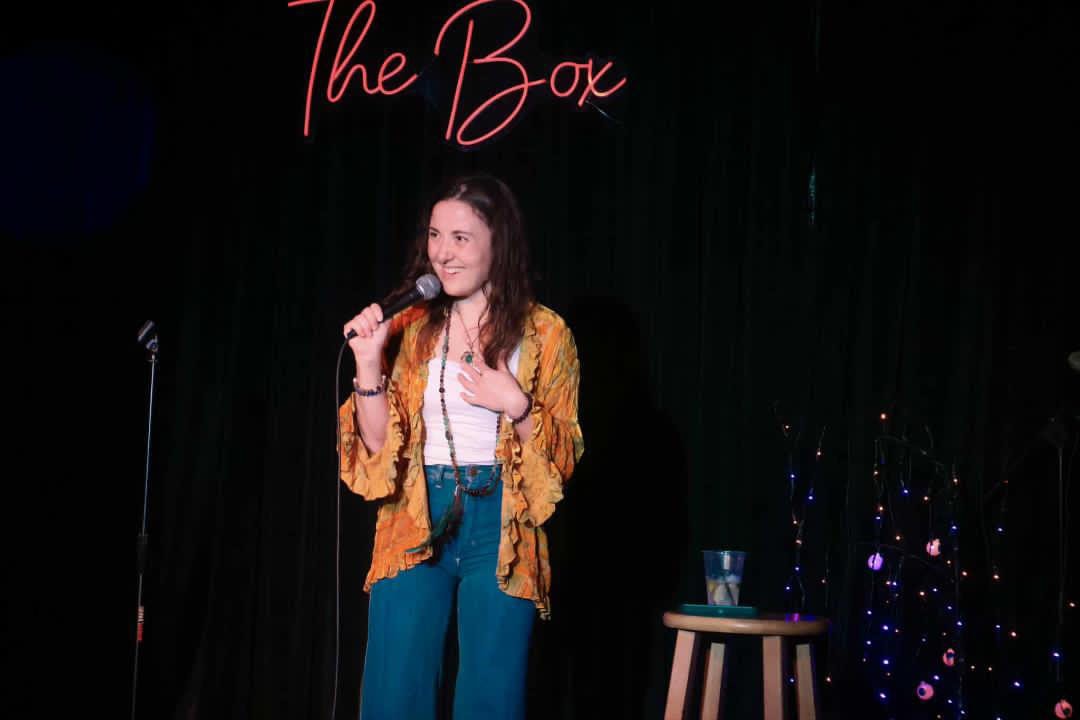
Her origin story is a sitcom already.
“My family’s nuts. I talk about them on stage. My mom’s a Jew from Brooklyn. My dad’s a hog farmer from Missouri. I grew up in California. And I have a twin sister who has blonde hair and blue eyes and looks nothing like me.”
Hannah didn’t grow up trying to be funny. She grew up inside a system where humor was the family language, and not the gentle kind. “My mom was very passive aggressive… we’re taking digs, but we can say what we want to say if we make it funny. Very New York.” That’s not just a line, it’s training. You learn early that humor lets you say the thing without saying the thing.
She didn’t grow up on standup. She grew up on “funny.” A lot of comics talk about the standup specials they watched as kids. Hannah didn’t. She had sitcoms. Movies. The Oscars. Comedy as culture. “I joke the three saints in my house were Barbra Streisand, Spielberg, and the Oscars.”
Standup wasn’t the dream. The dream was New York. The dream was a sitcom.
“I wanted to move to New York, because all the shows I loved were in New York. I wanted to be on a sitcom, so I went into acting.”
Her first job in New York was at Gotham Comedy Club. “I kind of feel like it was fate… I had no idea what standup comedy was… the only thing I’d seen from standup, I thought it was terrible, was Sex and the City.”
Later, in acting school, they offered a standup elective. “And I was like, fuck you. Why am I gonna take your class? I work at the comedy club. I’ll take their class.” That’s Hannah. Slightly aggressive. Completely correct.
“First time I ever hit the stage was 2012… I was 20. And I would stop-start, stop-start.”
She was young. She thought the money logic didn’t justify the pain. But she kept the identity.
“Once I started, even if I stopped, I still always identified as a comic.”
That’s the part people don’t see. The identity often locks in long before the career does.
Moving to Houston
A lot of people talk about leaving New York like they’re exiting the center of the universe. Hannah’s take was sharper.
“In New York, you have at least 20 mics a night… you could get on stage 25 or 30 times a week.”
Sounds incredible, until you hear the other side.
“It’s a lot easier to get reps… but it’s a lot harder to get quality stage time. And by quality, I mean stage time with an active audience.”
She explained New York economics like a gym membership you didn’t realize was also a tax. “You have to pay every time you want to perform… bringer shows… have five friends pay $20 and buy two drinks so you can get five minutes.”
Houston, by comparison, felt almost generous.
“In Houston… people are spoiled here… you do an open mic which is rehearsal, and there’s people actually listening.”
“Houston is a great place to get good. New York is where you can move money and get discovered if you’re good… but even then it could take 10 to 20 years.”
Houston sharpened her ambition.
Comedy, in her world, is craft, not vibes.
She isn’t romantic about the process and she’s definitely not a “just wing it” comic. She talks about standup like an athlete talks about training.
“If you go on standup to purely improv, it’s very frowned upon.”
Not because improv is bad. Because standup is discipline.
“The discipline and the pain is that it has to feel spontaneous and fresh… like you’re discovering it with the audience every night. But it’s not. It’s something you went over and over again.”
That’s the invisible part. The audience wants first-time energy. The comic delivers hundredth-time precision.
Even then, your own brain can mess with you.
“I’m halfway through my favorite bit… and I have an out of body experience like, man, I feel like y’all might already know this joke.”
So her solution isn’t to harden up. It’s to stay present.
“I need to slow down… look at people in the audience… I can feel when I’m doing a monologue versus being present.”
“If I do a joke and it doesn’t get the response I want, I just acknowledge it… ‘okay, y’all didn’t like that.’ And it always gets a laugh because it’s such a relief.”
That’s not just technique. That’s emotional intelligence under pressure.
Witchy Wednesdays
She hosts an open mic every Wednesday at 10pm at The Secret Group called Witchy Wednesday.
“I have the tarot cards where I read a card before your set… and then I have a cauldron with prompts, Kill Mary Fuck… things like that.”
It sounds chaotic, and it is. But it’s also intentional. She’s building a room where comics can loosen up, riff, experiment, and still respect structure. It’s basically yoga, just louder and with more swearing.
The dream
When we talked about ambition, there was no fake modesty and no forced branding.
“Ultimately, my dream has always been to have my own sitcom.”
Not a pitch deck. Not a roadmap. Just a long-held vision that hasn’t left.
“If somebody were to come to me and be like, ‘we like what you talk about on stage, we want to do a show with you,’ I’d be like, absolutely.”
That’s Hannah. Loud. Clear. Still building, still dreaming.
She’ll tell you who she is before you buy the ticket.
“I’m a hippie… I’m not for the faint of heart. I’m loud. I’m vulgar. But I don’t think I’m gross for the sake of being gross.”
And if you’ve seen her, you know the rest. The yellow pants. The energy. The what-the-hell-is-about-to-happen factor. That tension is the hook.
Houston keeps producing these characters who feel like they’re one decision away from leveling up.
Hannah is one of them.